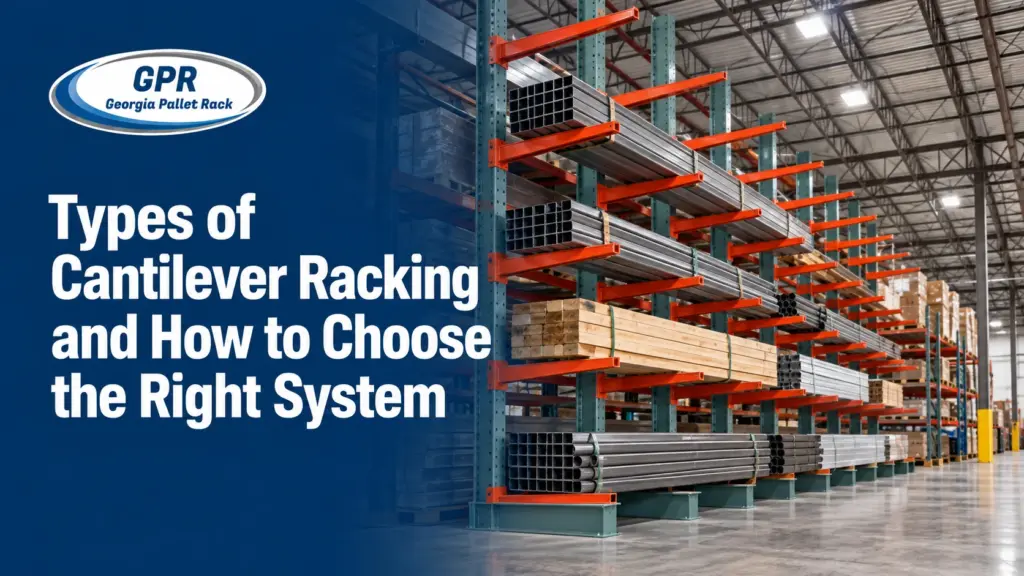
Cantilever racking is designed for storing long, bulky, or irregularly shaped materials that do not fit comfortably on standard pallet racks. Items such as lumber, pipes, steel bars, furniture, carpet rolls, and construction materials often need open-front storage with fewer structural obstructions. Understanding the different types of cantilever racking can help warehouse owners choose a system that improves organization, accessibility, and available space.
Unlike conventional pallet racks, cantilever systems use vertical columns with horizontal arms extending outward. This open design allows products to be loaded from the front using a forklift, crane, or other material-handling equipment.
What Is Cantilever Racking?
A cantilever rack consists of a vertical column, base, horizontal arms, and stabilizing braces. The arms support loads without requiring front columns, making it easier to store long products that cannot be placed safely on standard beams.
The arms can usually be adjusted to different heights. This flexibility allows businesses to create storage levels that match the size of their inventory. Cantilever systems can be installed as single-sided or double-sided racks, depending on whether products need to be accessed from one or both sides.
Types of Cantilever Racking
Single-Sided Cantilever Racks
Single-sided systems are designed to be placed against a wall or along the edge of a storage area. The arms extend toward the aisle, allowing products to be loaded and removed from one direction.
This type can be useful when floor space is limited or when the warehouse layout has defined perimeter storage areas.
Double-Sided Cantilever Racks
Double-sided cantilever racks have arms extending from both sides of the vertical columns. They can store more products in a central warehouse area and allow access from two directions.
This design may improve space utilization in larger facilities, but it requires enough aisle width for safe equipment movement on both sides.
Light-Duty Cantilever Racks
Light-duty systems are intended for smaller or lighter materials, such as trim, plastic tubing, small furniture components, or packaged products. They may be suitable for workshops, retail backrooms, and smaller storage areas.
Although the loads are lighter, the system still needs to be selected and installed according to the product weight and arm capacity.
Heavy-Duty Cantilever Racks
Heavy-duty cantilever racks are built for demanding applications involving materials such as steel, concrete forms, large timber, pipes, and other dense products. They use stronger columns, arms, bases, and braces to support higher loads.
Heavy-duty storage requires careful planning. The total load, load distribution, forklift capacity, floor conditions, and rack height should all be reviewed before installation.
Mobile Cantilever Racks
Mobile systems are mounted on rails or movable bases, allowing racks to be repositioned when access is needed. This design can reduce the number of fixed aisles and increase storage density.
Mobile cantilever racking may require a higher investment and more detailed planning than fixed systems. It is generally considered when maximizing floor space is a major priority.
How to Choose the Right Cantilever System
Evaluate Product Dimensions
Measure the length, width, height, and shape of the materials being stored. Consider whether products can be bundled, whether they require individual access, and how much space is needed between loads.
The rack arms should provide sufficient support without allowing materials to extend into walkways or forklift paths. Uneven or unstable loads may require additional supports or handling procedures.
Calculate Load Capacity
Determine the weight of individual products and the total load each level must support. Capacity depends on the column design, arm length, number of storage levels, and how the weight is distributed.
Never choose a system based only on average load weight. The heaviest expected products should be included in the planning process, and capacity information should be clearly marked after installation.
Consider Access and Equipment
Think about how materials will be loaded and removed. Forklifts require adequate aisle width and turning space, while cranes or manual handling may require a different layout.
The system should allow employees to retrieve materials without climbing on racks or reaching into unstable loads. Safe access is an important part of an efficient storage plan.
Review Available Space
Measure the ceiling height, floor area, wall locations, loading zones, emergency exits, and nearby equipment. Single-sided racks may work well along walls, while double-sided systems may be better suited to open warehouse areas.
Also consider future expansion. A modular layout may make it easier to add storage levels or extend the system as inventory grows.
Installation and Safety Considerations
Cantilever racking should be installed on a suitable, level floor and anchored according to the system design and facility requirements. Employees should be trained to place loads evenly, avoid exceeding capacity, and report damaged arms, columns, or braces.
Regular inspections can identify bent components, loose connections, corrosion, or impact damage before these issues affect stability. Forklift operators should also maintain safe speeds and clearance around the rack structure.
Georgia Pallet Rack provides warehouse storage products and related services for businesses in Georgia and the greater Atlanta area. Its offerings include pallet racking systems, used pallet racks, uprights, step beams, pallet supports, and row spacers. The company also provides rack installation, replacement, take-down, relocation, and custom storage solutions. For businesses evaluating cantilever racking or other warehouse systems, these services can support a storage plan based on inventory requirements, facility layout, equipment, load capacity, and safety considerations.